

 13th October 2025 marks 250 years since the founding of the U.S. Navy. Over that time, there has been a vast amount of technological change, such as the transition from hand-cranked submarines to complex underwater vehicles, from bulky computer servers to easily-transportable and wearable ones, and from flag signals to advanced radio communications. In the USA, Ultralife is proud to manufacture portable power solutions and communications systems that serve the modern U.S. Navy's need for underwater vehicles, edge computing and advanced radio communication.

Underwater vehicles
250 years ago, the world's first submarine, the American Turtle was designed. Although unsuccessful in its missions, it paved the way for the many highly effective submarines and submersibles that followed, which were successfully used for ISR tasks until the 1990s. Then, such tasks started being transferred to unmanned underwater vehicles (such as AUVs and ROVs), which can operate in areas where it's too risky or inefficient to send a manned sub.
This has proven to be so successful that today's U.S. Navy is investing around $1bn in underwater vehicles, especially unmanned systems. There are multiple programs underway or recently completed, spanning mine countermeasures, surveillance, anti-submarine warfare, and oceanographic data gathering.
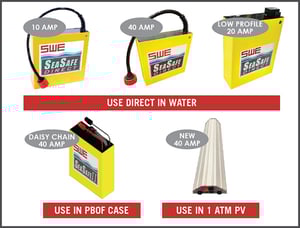 One of the navy's top priorities is ensuring that these underwater vehicles can operate reliably for extended periods in order to explore vast areas before having to return to the surface.
Southwest Electronic Energy (an Ultralife company) manufactures rechargeable SeaSafe batteries that offer 4x longer run-time than traditional sealed lead acid batteries. The SeaSafe® range is certified to American Bureau of Shipping (ABS) standards that are similar to NAVSEA and DNV.

Edge computing
The Navy was one of the earliest adopters and innovators of computing technology but early servers were extraordinarily heavy. Some mainframes in the mid-20th century weighed thousands of pounds. By the 1960s, a new generation of transistorized "minicomputers" reduced the size and weight, but still weighed hundreds of pounds.
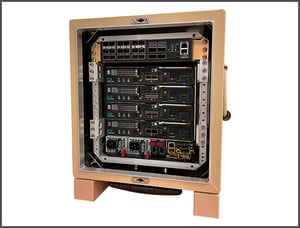 By comparison, modern servers (such as HPE Edgeline) weigh around 50lbs (23Kg) and are significantly smaller in size. A modern server and all of its associated components can be carried down a narrow ship corridor. Even when housed in a secure and durable case manufactured by Ultralife, the total weight comes in at around 100lbs (45Kg), which can be carried by two people. Ultralife paid particular attention to this, by placing handles at the front and back, when designing the case. This allows one sailor to walk at the front and another at the back when the corridor is too narrow for them to walk side-by-side.
However, this is not the smallest, lightest solution available. Ultralife is developing a sailor-wearable Edge computing server, called The Crescent Server, which weighs around 6lbs (3Kg). It can operate for up to 8 hours with only a single battery swap.


Advanced radio communication
Early military radios often used dry cell batteries or wet cell (lead-acid) batteries to provide the necessary voltage for vacuum tubes. These early batteries were large and cumbersome and portability was limited, even for “portable” field radios. Some radios required battery packs weighing 15–30lbs (7-14Kg) or more.
Since the early 2000s, rechargeable 2590 batteries have been used by the Navy, Army and Marines to power handheld and backpack radios (e.g., AN/PRC-117, PRC-152, PRC-160). These batteries weigh only 3.2lbs (1.5Kg), a dramatic improvement.
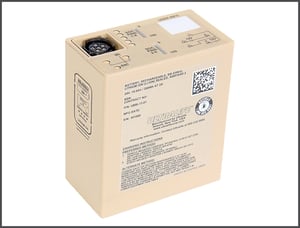 20 years later, military radios are advancing to incorporate features such as increased frequency bands and communication modes, frequency hopping, end-to-end encryption, increased interoperability, GPS and blue force tracking (BFT) and more, for which more power is needed. Therefore, Ultralife is focused on adapting its 2590 batteries accordingly. The result is a version of UBBL13-01 modified to safely deliver up to 15 or even 30 amps compared with the standard 10.
2590 batteries can also be used for laser designators / rangefinders, portable sonar and hydrophones, EOD (Explosive Ordnance Disposal) robots and sensors, and portable unmanned underwater vehicle (UUV) control units.

To learn more about Ultralife's portable power solutions and communications systems that are manufactured in the USA for the U.S. Navy, please contact us. Our applications engineering team are available to discuss your requirements and are working to help the Navy stay at the forefront of technological advancements for the next 250 years and beyond.
