

 A recent article in Environmental Protection magazine reports that ‘Internal water leaks are the number one cause of property damage in commercial buildings, surpassing fire, theft, and weather-related events combined’ and that ‘Water-damage deductibles of $100,000 to $200,000 are now common’. It is therefore essential to have reliably powered smart meters and water leak detectors that continuously look for signs of a leak.
Power failure is not an option when it comes to devices that can save properties and lives, such as pipe-fitted leak detectors, portable leak detectors and smart meters. These are applications in which the battery manufacturer Ultralife Corporation specializes. The company started out as a detector battery manufacturer – over 30 years ago – and has sold over 100 million batteries containing its small and light Thin Cells®. Additionally, Ultralife’s engineers worked closely with metering manufacturers to develop the ER Generation X range of Lithium Thionyl Chloride cells. These robust batteries are made from 100% stainless steel, so do not rust, and the D-size bobbin cell variant has a leading capacity of 19Ah, reducing the need for replacement.


Pipe-fitted leak detector batteries
Pipe-fitted leak detectors are often permanently installed into commercial properties and can automatically shut down the water supply in the event of a leak.
Although often powered by AC mains, they will utilize batteries if the pipes are in a remote location without wiring access, or where the detector communicates via wireless rather than cabling.
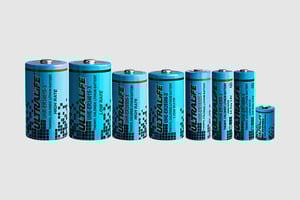 Lithium Thionyl Chloride batteries are well-suited for use in remote applications, as they have a high energy density (exceeding 400Whr/Kg) that results in a long service life. Additionally, the high and stable operating voltage of Lithium Thionyl Chloride batteries provides consistent performance, maintaining the accuracy and reliability of data transmission over time.
Portable leak detector batteries
Alternatively, portable leak detectors are ideal as a temporary measure or when installing fixed sensors is not feasible (e.g., temporary setups, rented spaces, complex legacy piping). Small devices, measuring as thin as 1.5cm, they can easily be moved between offices and buildings. Additionally, using multiple portable leak detectors often works out much cheaper than equipping an entire facility with fixed sensors.
If water around them reaches a certain level, an alarm will sound or a notification will be sent to a smartphone. Due to the small size of the device, many use Lithium Coin Cells but Ultralife Thin Cells® (containing Lithium Manganese Dioxide chemistry) offer significant advantages.
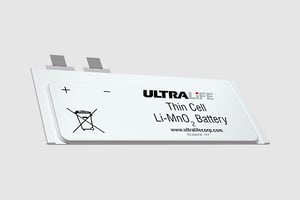 With thicknesses as low as 1.1mm and an energy density of around 500Wh/l and 400Wh/Kg, compared to just 300Wh/l and 260Wh/Kg for the best lithium coin cells, Ultralife Thin Cells® are ideal for embedding into discreet devices. Not only are they available in many different shapes and sizes, they also offer high performance thanks to low resistance current collectors that help to deliver the high bursts of energy required for data transmission.
Smart meter batteries
In addition to both types of leak detectors, smart meters can show signs of a water leak by displaying spikes in water consumption. Fitted with advanced sensors, many smart meters monitor water consumption in real-time, allowing businesses to take corrective measures quickly.
Most major energy suppliers offer a mobile app that displays the data collected by smart meters, allowing business customers to track their energy usage even when they are out of the office.
All of this relies on the smart meter having a reliable power source that allows it to record or transmit data accurately. Even smart meters that are powered by AC mains will often integrate a battery in-case of AC mains failure. However, not all batteries are manufactured to the same standards and offer the same performance, so it is important that smart meter manufacturers undertake a thorough assessment.
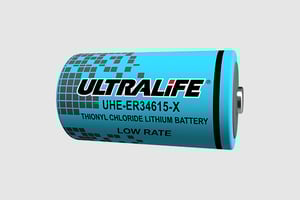 For example, Ultralife’s D size bobbin cell offers an industry leading capacity of 19Ah that helps it to be embedded for the lifetime of the device.
Furthermore, by adding ultracapacitors as part of a battery system, Ultralife's D size cell can support the latest 5G-compatible smart meters that demand a periodic, high-power consumption.
Water leak detectors and smart meters are only as effective as the batteries that power them. With water leaks now the leading cause of commercial property damage and insurance deductibles reaching six figures, having reliable water leak detectors and smart meters has never been more important.
